 Skip to content

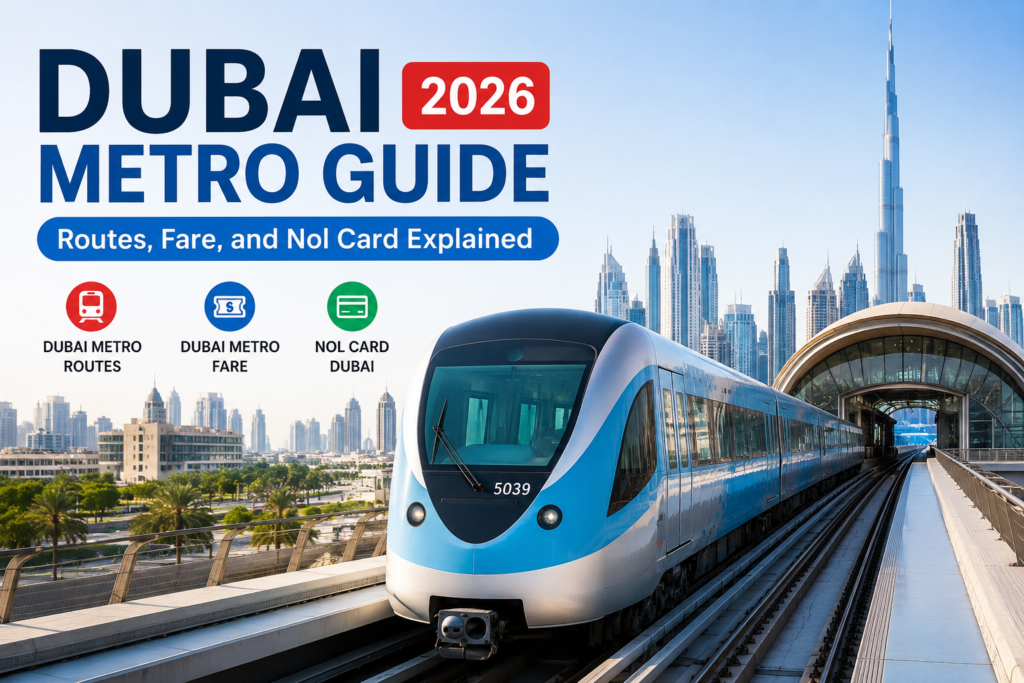
Dubai Metro Guide 2026: Introduction
Dubai’s driverless metro system is clean, reliable, and designed to make public transportation simple for both residents and visitors. Whether you’re heading to Burj Khalifa, Dubai Mall, Dubai Marina, the Museum of the Future, or the historic districts of Old Dubai, the metro connects many of the city’s most popular destinations while helping you avoid traffic and reduce transportation costs.
This guide is written for first-time visitors, families, solo travelers, and budget-conscious tourists who want clear, accurate, and easy-to-follow information in one place. You’ll learn how the metro works, which Dubai Metro Routes to take, how much the Dubai Metro Fare costs, which Nol Card Dubai is best for your trip, and how to avoid common mistakes that many visitors make.
By the end of this guide, you’ll know how to use Dubai’s public transport system efficiently, save money on local travel, and spend more time exploring the city instead of figuring out how to get around. Let’s start with an overview of the Dubai Metro and why it has become one of the most convenient ways to explore Dubai.
Quick Answer Box
📌 Dubai Metro is the fastest and most affordable public transport system in Dubai. It connects major attractions, airports, shopping malls, and business districts using two main lines: the Red Line and the Green Line.
Table of Contents
The Dubai Metro’s Red Line offers connections from DXB Terminals 1 and 3, operating: Monday to Thursday: 5AM – midnight
Friday: 5AM – 1AM (next day)
Saturday: 5AM – midnight
Sunday: 8AM – midnight
Please note, service hours may extend during public holidays and citywide celebrations.
For the latest timings, always check the RTA website.
Dubai Metro is easy to navigate, with two lines – Red and Green – offering seamless connections to buses, taxis, major hotels, and key attractions across the city. Guests can plan their journey using the RTA’s s’hail application.
Metro Red line passes are available at ticket offices and vending machines in DXB Terminals 1 and 3. For added convenience, guests may purchase a Nol Card, available in different types (Gold and Silver). For more information on fares and travel zones, please click here.
Travel light with up to two pieces of luggage, including hand luggage. For detailed information on luggage size and weight restrictions, visit the RTA website.
Guests can connect to DWC via RTA buses or taxis from Ibn Battuta and Expo 2020 Metro Stations. Journey planning is available through the RTA’s s’hail application.
Dubai Metro Guide 2026
The first impression of moving around Dubai is often shaped not by its skyline or shopping malls, but by how smoothly you can get from one landmark to another. The Dubai Metro Guide 2026 offers a clear way to understand that experience before you even step off the plane. For first-time visitors, the metro is not just transport; it is a structured system that quietly connects the city’s most important districts without the stress of traffic or complex navigation.
This Dubai Metro Guide 2026 is designed for travelers who want clarity before arrival, especially those trying to understand how the system works, what it costs, and how to move between major attractions efficiently. Whether you are a tourist planning your itinerary or a family trying to avoid expensive taxis, the metro becomes an essential part of the journey rather than just a commuting option.
What is Dubai Metro?
What makes the Dubai Metro particularly interesting is how it reflects the city’s design philosophy: fast, organized, and built for scale. Managed by Roads and Transport Authority, the network operates with a level of punctuality and cleanliness that surprises many first-time users. It is fully driverless, fully air-conditioned, and structured in a way that allows travelers to navigate the city without needing deep local knowledge.
For visitors arriving for the first time, the system can feel almost too simple at first glance. Yet behind that simplicity is a carefully planned network that connects airports, business hubs, residential zones, and major tourist attractions. Understanding how the metro fits into daily movement in Dubai helps travelers avoid unnecessary costs and saves valuable time during short stays.
Dubai Metro Routes
At the heart of this system are the Dubai Metro Routes, which are divided mainly into the Red Line and Green Line. These lines are not just transportation paths; they are carefully designed corridors that connect key areas like Downtown Dubai, Dubai Marina, Deira, and Bur Dubai. The Red Line, in particular, is the backbone for tourists because it links the airport with major attractions and hotel districts. The Green Line, on the other hand, serves older parts of the city and provides a more local perspective of everyday life.
Each route is structured to reduce confusion, with clearly marked stations and consistent signage in English and Arabic. For travelers unfamiliar with the city, this level of clarity plays a major role in making the metro feel approachable. It also means that even during peak travel hours, navigating between stops remains straightforward, provided you understand the direction of travel and the interchange points.
Red Line
At the heart of this system are the Dubai Metro Routes, which are divided mainly into the Red Line and Green Line. These lines are not just transportation paths; they are carefully designed corridors that connect key areas like Downtown Dubai, Dubai Marina, Deira, and Bur Dubai. The Red Line, in particular, is the backbone for tourists because it links the airport with major attractions and hotel districts.
Green Line
The Green Line, on the other hand, serves older parts of the city and provides a more local perspective of everyday life.
Dubai Metro Fare
Beyond routes, one of the most important aspects for any visitor is understanding the Dubai Metro Fare system. Unlike many global metro networks with fixed ticket prices, Dubai uses a zone-based structure. This means the cost depends on how many zones you travel through, not just how far you go in distance. For short trips within a single zone, fares remain affordable, making it an attractive option for budget-conscious travelers.
However, the fare system becomes more important when planning longer journeys across multiple districts. Travelers who stay in Dubai for several days often find that learning the fare structure early helps them plan better daily routes. Instead of guessing costs, they can estimate travel expenses and decide when it is worth taking the metro versus other transport options.
Nol Card Dubai
Closely linked to this system is the Nol Card Dubai, which acts as the key to accessing all public transport services. The Nol Card is more than just a ticket; it is a rechargeable smart card that allows seamless travel across the metro, buses, and even some water transport services. For visitors, it removes the need to buy individual tickets for every trip, which simplifies movement significantly.
There are different types of Nol cards depending on usage needs, but most tourists rely on the standard versions that can be topped up as required. The process of using the card is straightforward: tap in at the station gate, travel, and tap out when you arrive. The fare is automatically deducted based on your journey, which removes guesswork and speeds up the entire experience.
For families traveling with children or solo travelers trying to optimize their itinerary, the Nol Card becomes an essential tool. It allows flexibility without locking you into fixed travel plans. If your day changes unexpectedly, the card still works without requiring adjustments. This adaptability is one of the reasons the metro system integrates so well into tourism in Dubai.
Dubai Metro Timings
What often surprises visitors is how the metro experience changes depending on the time of day. Early mornings tend to be calm and efficient, while evenings bring a steady flow of commuters and tourists returning from attractions. Understanding these patterns helps travelers plan smoother journeys, especially when moving between popular districts.
Quick Reference Tables for Dubai Metro Travel
Experienced travelers often don’t read long explanations when planning routes. They look for clarity at a glance. These tables simplify the most important parts of the Dubai Metro system so you can plan your movement across Dubai with confidence and speed.
Dubai Metro Stations and Key Attractions
| Station | Attraction Nearby | Approx. Travel Time |
|---|---|---|
| Burj Khalifa/Dubai Mall | Burj Khalifa, Dubai Mall | 2–5 minutes walk |
| Mall of the Emirates | Ski Dubai, Mall of the Emirates | Direct access |
| BurJuman | Bur Dubai heritage district | 5–10 minutes |
| Union | Deira shopping markets | 5–8 minutes |
| DMCC | Dubai Marina | 5–7 minutes |
| Airport Terminal 1 | DXB Terminal 1 | Direct access |
| Financial Centre | Business Bay, DIFC | 5–10 minutes |
These stations form the backbone of daily tourist movement. Most first-time visitors rely heavily on the Red Line because it connects airport access with major landmarks in a single route.
Dubai Metro Fare Structure (Zone System)
| Fare Type | Zone Coverage | Estimated Price (AED) |
|---|---|---|
| Short Trip | 1 Zone | 3 – 4 AED |
| Medium Trip | 2 Adjacent Zones | 5 – 7 AED |
| Long Trip | More than 2 Zones | 7.5 – 10 AED |
| Airport Route | Special Zone Access | 6 – 10 AED |
The fare system is strictly distance-based using zones, not fixed station pricing. This means two journeys of similar length can cost differently depending on how many zones you cross during travel.
Nol Card Dubai Overview
| Card Type | Main Benefits | Approx. Cost / Requirement |
|---|---|---|
| Red Ticket | Short-term tourist use | 2 AED (card) + top-up |
| Silver Card | Standard travel flexibility | 25 AED initial credit included |
| Gold Card | Premium seating access | Higher fare per trip |
| Blue Card | Registered user benefits | Personalized balance protection |
The Nol Card Dubai system is designed to remove friction from daily travel. One tap at entry and exit automatically calculates your Dubai Metro Fare, whether you are crossing one station or several zones.
For tourists, the Silver Card remains the most practical option because it balances cost, convenience, and flexibility without requiring registration.
8. Use Bullet Points
Dubai Metro Guide 2026 —Friendly Overview
The Dubai Metro Guide 2026 is built for travelers who want clarity, not confusion. It helps you move across Dubai without stress, delays, or expensive taxis. Below is everything you need in a format that feels simple, real, and practical.
Why the Dubai Metro Works So Well
✔ Fast connection between major city zones
✔ Fully air-conditioned trains and stations
✔ Clean, safe, and strictly maintained system
✔ Budget-friendly for tourists and daily travel
✔ Easy navigation with English + Arabic signage
✔ Managed by Roads and Transport Authority (RTA)
Dubai Metro Routes (What Actually Matters)
✔ Red Line connects airport, Marina, Downtown
✔ Green Line covers old Dubai (Deira, Bur Dubai)
✔ Clear interchange stations for smooth transfers
✔ Tourist hotspots directly linked to metro stops
✔ Frequent trains reduce waiting time
✔ Simple direction-based navigation system
Dubai Metro Fare
✔ Zone-based pricing system (not fixed distance)
✔ Short trips = lowest fare range
✔ Longer cross-zone travel = higher fare
✔ Airport routes have separate fare structure
✔ Automatic deduction through Nol Card Dubai system
✔ Ideal for budget-conscious travelers
Nol Card Dubai (What You Should Know)
✔ Rechargeable smart travel card for all transport
✔ Works on metro, buses, and select water transport
✔ Tap in and tap out system (fully automated fare)
✔ No need to buy tickets for every journey
✔ Available in Silver, Gold, Red, and Blue types
✔ Best option for tourists staying multiple days
Dubai Metro Experience (Real Travel Insight)
✔ Trains run frequently during peak hours
✔ Separate cabins for women, children, and Gold Class
✔ Extremely clean and well-monitored stations
✔ Comfortable travel even during busy hours
✔ Easy access to malls, attractions, and hotels
✔ Reliable alternative to road traffic delays
Dubai Metro Routes — Why Tourists Prefer Them
✔ Direct access to major landmarks
✔ Simple route map for first-time visitors
✔ Less walking compared to bus networks
✔ Strong connectivity across tourist zones
✔ Ideal for solo travelers and families
✔ Saves time during short stays in the city
Dubai Metro Fare Strategy (Smart Travel Tip)
✔ Travel within one zone whenever possible
✔ Use Nol Card to control daily travel cost
✔ Plan trips around metro lines, not taxis
✔ Combine walking + metro for savings
✔ Avoid peak-hour congestion for smoother rides
Nol Card Dubai Benefits (Why It Matters)
✔ One card for all public transport
✔ No need for cash or paper tickets
✔ Automatically calculates best fare
✔ Easy top-up at stations and kiosks
✔ Works across entire transport network
Pro Tips (What Most Guides Don’t Tell You)
These are the small, real-world details that experienced travelers quietly learn after a few rides on the metro across Dubai. They are not usually highlighted in standard guides, but they make a noticeable difference in comfort, timing, and overall travel experience.
💡 TourProfessor Tip: Choose the “middle of the train” trick
Most passengers crowd near the entrance doors, especially on the Red Line. Walk a few steps deeper inside the carriage. You will almost always find more space and a quieter ride without changing your route.
💡 TourProfessor Tip: Avoid just the morning peak — watch the “second wave”
Everyone talks about rush hour, but the quieter window is often misunderstood. Even after 9:30 AM, there is a smaller “late rush” of school groups and short commuters. The calmest travel is usually between 10:15 AM and 11:30 AM.
💡 TourProfessor Tip: Not all stations are equal for comfort stops
If you need a break, choose interchange stations like Union or BurJuman. They are designed for flow, not pause, which means cleaner seating areas and faster movement between platforms.
💡 TourProfessor Tip: Use exit direction before you tap out
Many first-time visitors lose time after exiting stations. Always check which exit number leads closest to your destination before tapping out your Nol Card Dubai. Once you exit, walking distance can double if you choose the wrong side.
💡 TourProfessor Tip: Gold Class is not just luxury — it’s timing strategy
On busy evenings, Gold Class cabins are not only about comfort. They often stay less crowded than standard cabins, especially near Dubai Marina and Downtown stops.
💡 TourProfessor Tip: Don’t follow Google Maps blindly underground
Inside stations, walking paths can be longer than expected. Follow metro signage instead of shortest-map routes. The internal design prioritizes flow over distance, not speed.
💡 TourProfessor Tip: The quietest rides are not early mornings
Contrary to popular belief, the calmest metro experience is often mid-afternoon on weekdays. Trains run empty between major commuter peaks, and seating availability is significantly higher.
Did You Know? (Surprising Facts About Dubai Metro)
These are the kinds of details most visitors never hear, yet they quietly shape how the metro works across Dubai. They are simple, real, and often overlooked in standard travel guides.
🚆 Did You Know?
The Dubai Metro runs without a driver at all. Every train is fully automated and controlled by a central system, making it one of the most advanced transport networks in the region.
🚆 Did You Know?
Some stations are designed with platform screen doors that open only when the train arrives. This improves safety and also keeps station temperatures stable in extreme heat.
🚆 Did You Know?
The entire system is operated by the Roads and Transport Authority, which coordinates trains, timing, and fare collection through a single integrated network.
🚆 Did You Know?
The Dubai Metro Route design intentionally avoids sharp curves and steep gradients, which helps trains run smoother and reduces travel noise inside cabins.
🚆 Did You Know?
The Nol Card Dubai system is not limited to the metro. The same card can be used across buses, trams, and even selected water transport routes, making it a unified travel system.
🚆 Did You Know?
Some stations are built with architectural themes inspired by elements like earth, fire, water, and air, giving each stop a distinct identity rather than a generic design.
🚆 Did You Know?
Peak-hour train frequency is so high on key Dubai Metro Routes that trains often arrive within just a few minutes, reducing the need for fixed travel planning.
🚆 Did You Know?
The system was designed to support long-term urban expansion, meaning many stations were planned years before surrounding neighborhoods were fully developed.
Pros & Cons of Dubai Metro (Real Travel Perspective)
Every transport system has its strengths and limitations. The Dubai Metro Guide 2026 is no different. Understanding both sides helps you plan smarter travel across Dubai instead of relying on guesswork.
👍 Pros
✔ Extremely affordable
One of the most budget-friendly ways to move across the city compared to taxis or private transport.
✔ Clean and well-maintained
Stations and trains are consistently kept in excellent condition, even during peak hours.
✔ Fast and time-efficient
Direct routes like Dubai Metro Routes Red and Green Lines reduce travel time between major districts.
✔ Safe for all travelers
Strong monitoring systems, clear signage, and dedicated cabins make it suitable for solo travelers and families.
✔ Easy payment system
Nol Card Dubai allows seamless tap-in and tap-out travel without buying tickets each time.
✔ Air-conditioned comfort
Fully climate-controlled stations and trains make travel manageable even in extreme summer heat.
👎 Cons
✔ Crowded during peak hours
Morning and evening rush hours can feel congested, especially on major commuter routes.
✔ Limited late-night frequency
Train intervals increase later in the evening, which can slow down spontaneous travel plans.
✔ Not always door-to-door
Some attractions still require walking or short transfers after exiting the station.
✔ Route limitations for certain areas
Not every part of the city is directly connected, so alternative transport may still be needed.
✔ Peak travel planning needed
Without timing awareness, journeys may take longer due to passenger volume on popular lines.
Common Mistakes Travelers Make on the Dubai Metro
Even the most well-planned trip across Dubai can slow down if you miss a few simple details. The Dubai Metro Guide 2026 is not just about routes and fares—it’s also about avoiding the small errors that quietly cost time, money, and comfort.
❌ Using the wrong Nol Card Dubai type
Many first-time visitors pick a card without understanding usage needs. For short stays, the wrong card can limit flexibility or lead to unnecessary top-ups.
❌ Forgetting to tap out
The system automatically calculates the Dubai Metro Fare based on entry and exit. Missing the tap-out step can result in incorrect fare charges or system penalties.
❌ Traveling during peak rush hours without planning
Morning and evening peaks on key Dubai Metro Routes can feel crowded. Without timing your journey, even short trips can become slower than expected.
❌ Standing at the wrong platform direction
The metro runs in clear directions, but beginners sometimes board the wrong side, especially at interchange stations.
❌ Not checking exit numbers before arrival
Large stations have multiple exits. Choosing the wrong exit can add extra walking time under the heat.
❌ Assuming all attractions are walking distance
Some stations look close to landmarks, but walking distances can be longer than expected, especially in business and tourist districts.
❌ Ignoring off-peak travel advantage
Midday travel is often much smoother, but many tourists stick only to early or late hours, missing the easiest
10 Best Tips Before You Travel on the Dubai Metro
A smooth journey across Dubai is rarely about luck. It’s about knowing a few simple habits that experienced travelers quietly follow. These tips are practical, real, and based on how the system actually works—not theory.
✔ Buy a Silver Nol Card Dubai for flexibility
It is the most practical option for tourists who want easy top-ups and unrestricted travel across Dubai Metro Routes.
✔ Plan routes before you enter the station
Check your line and direction in advance. It saves confusion at interchange stations and avoids unnecessary backtracking.
✔ Travel during off-peak hours when possible
Mid-morning and early afternoon rides are noticeably more comfortable than rush hours.
✔ Use Google Maps, but double-check metro signage
Maps help with planning, but station signs inside the metro are more accurate for real-time direction.
✔ Carry a small water bottle
Stations are air-conditioned, but walking between exits and attractions can still be warm.
✔ Wear comfortable walking shoes
Some stations require longer walks than expected, especially when connecting to malls or attractions.
✔ Always tap in and tap out correctly
Your Dubai Metro Fare depends on it. Missing a tap can cause incorrect fare calculation.
✔ Keep your Nol Card charged in advance
Avoid last-minute top-ups during peak hours when queues can form.
✔ Choose the right exit before leaving the platform
Large stations often have multiple exits leading to different streets or attractions.
✔ Combine metro with short walks for efficiency
Not every destination needs a taxi. Many attractions are just a short, well-marked walk from the station.
14. Frequently Asked Questions
Add 8–10 FAQs based on real search intent.
Frequently Asked Questions (Dubai Metro Guide 2026)
These are the real questions travelers actually ask before using the metro across Dubai. They are simple, practical, and focused on real travel situations—not theory.
1. What is the easiest way to use the Dubai Metro for tourists?
The easiest way is to buy a Nol Card Dubai, top it up, and tap in and out at stations. It works across all Dubai Metro Routes.
2. How much is the Dubai Metro Fare for tourists?
Fares depend on zones. Short trips cost less, while longer cross-zone journeys cost more. Most rides stay budget-friendly compared to taxis.
3. Which metro line is best for first-time visitors?
The Red Line is the most useful because it connects the airport, Downtown Dubai, and Dubai Marina.
4. Can I use one card for all transport in Dubai?
Yes. The Nol Card Dubai works on metro, buses, trams, and selected water transport services.
5. Do I need cash to use the metro?
No. The system is cashless. You only need a Nol Card with enough balance.
6. Is the Dubai Metro safe for solo travelers?
Yes. It is one of the safest public transport systems in the region, with CCTV monitoring and dedicated cabins.
7. What happens if I forget to tap out?
The system may charge you the maximum fare for your journey, so always remember to tap out.
8. Are there trains late at night?
Yes, but frequency reduces after peak hours. It’s better to check timings if you are traveling late.
9. Can I carry luggage on the metro?
Yes. Small and medium luggage is allowed, especially useful for airport travel on Dubai Metro Routes.
10. Is the metro better than taxis in Dubai?
For budget travel and avoiding traffic, yes. However, taxis are better for direct door-to-door travel or late-
15. Conclusion
The Dubai Metro Guide 2026 explains how to move across Dubai in a simple, structured way that saves both time and money. It breaks down how the system connects major districts, how fares are calculated, and how travelers can use a single card for almost every journey in the city. For first-time visitors, this guide turns a complex transport network into something easy to understand and use from day one.
At the core of the system are the Dubai Metro Routes, which include the Red and Green Lines connecting airports, business hubs, shopping malls, and residential areas. The Dubai Metro Fare system follows a clear zone-based structure, meaning costs depend on distance traveled rather than fixed station pricing. This makes budgeting easier for tourists and families planning daily travel.
The guide also explains the importance of the Nol Card Dubai, a rechargeable smart card used across metro, buses, and other transport services. It removes the need for paper tickets and allows smooth tap-in, tap-out travel across the entire network.
For visitors who want stress-free movement across the city, the metro remains one of the most reliable options. It is clean, efficient, and well-connected to major attractions.
Ready to explore Dubai?
Check out more travel guides on TourProfessor to plan your perfect trip.





[…] Dubai Metro Guide 2026 Dubai Travel Guide 2026 Book With Tour […]